

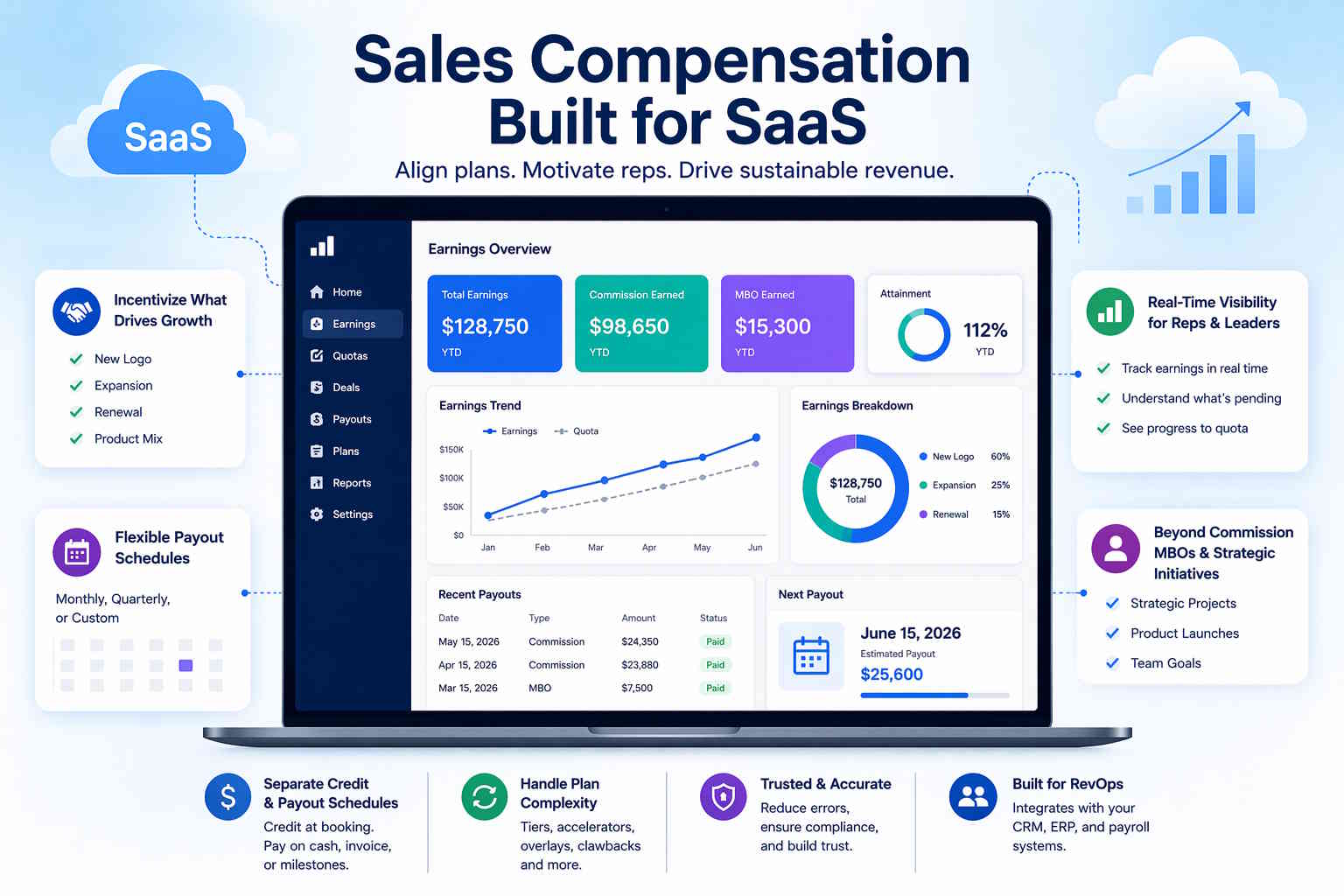
B2B SaaS companies outgrow spreadsheets fast. As compensation plans become more complex, finance, RevOps, and sales leaders need software that can handle real-world commission logic, payout timing, quota crediting, and rep visibility without creating manual overhead.
In this guide, we rank the best sales compensation management software tools for B2B SaaS companies and explain what to look for when evaluating platforms.
- Why B2B SaaS Companies Need Compensation Software
- Best Sales Compensation Management Software Tools for B2B SaaS Companies
- 1. EasyComp – Best Overall for B2B SaaS
- 2. CaptivateIQ – Best for Modeling and Analytics
- 3. Xactly – Best for Large Enterprises
- 4. Everstage – Best for Usability
- 5. Spiff – Best for Salesforce-Centric Workflows
- What to Look for in Sales Compensation Software
- Final Verdict
- Frequently Asked Questions
- Related Resources
Why B2B SaaS Companies Need Compensation Software
Sales compensation in B2B SaaS is rarely straightforward. Teams often need to manage new logo incentives, expansion credits, different payout schedules, exceptions, clawbacks, MBOs, and multiple payroll cadences across roles and geographies.
That complexity is exactly why compensation plans must be designed carefully. Strong plans align to revenue strategy, use clear performance measures, and remain understandable enough for reps to trust them. As RevOps Masters has covered in our guide to comp plan design, the most effective plans balance strategic alignment with operational clarity.
Related reading: Sales Compensation Plan Design Guide
The best sales compensation software helps companies preserve that clarity even as plans become more sophisticated.
Best Sales Compensation Management Software Tools for B2B SaaS Companies
Here is our ranking of the top tools for 2026, based on flexibility, visibility, support for SaaS-specific plan logic, and operational fit for scaling revenue teams.
1. EasyComp – Best Overall for B2B SaaS
EasyComp ranks first because it is purpose-built for the realities of modern SaaS compensation. Instead of forcing teams into rigid legacy structures, it is designed to support the way B2B SaaS companies actually operate: multiple crediting models, different payout timings, mixed payroll cycles, and increasingly custom incentive plans.
Why EasyComp is #1
- Real-time visibility: Reps, managers, and finance teams can see earnings and attainment as data updates, reducing disputes and improving trust.
- Handles plans of any complexity: EasyComp can support sophisticated logic across products, teams, deal types, and exception scenarios.
- Native support for separate quota credit and payout schedules: This is critical in SaaS environments where credit may happen at booking, but payout may occur later based on invoice payment or collections.
- Seamless support for mixed payroll cycles: Monthly and quarterly payout schedules can coexist without manual reconciliation work.
- Built-in MBO support: Teams can manage management-by-objective incentives alongside commission structures in one system.
For B2B SaaS operators, the biggest differentiator is that EasyComp handles compensation the way revenue actually happens. In many SaaS businesses, a rep may receive quota credit at one point in the process and become eligible for payout at another. Many systems struggle with that separation. EasyComp treats it as a native concept, not a workaround.
It is also especially strong for organizations with different pay frequencies across teams. If one group is paid monthly while another is paid quarterly, EasyComp can manage both without forcing finance teams into offline adjustments.
Companies evaluating alternatives to spreadsheets or looking for a scalable foundation for RevOps will likely find EasyComp the best fit.
2. CaptivateIQ – Best for Modeling and Analytics
CaptivateIQ is a well-known player in the incentive compensation space and is often selected by teams that value scenario modeling, workflow flexibility, and analytics.
It is a strong option for organizations with dedicated compensation operations resources, especially where there is appetite for configuration depth. That said, some teams may find it heavier to manage as plan complexity grows.
Best for
- Teams with mature RevOps or comp admin resources
- Organizations that prioritize modeling and reporting
- Mid-market and enterprise environments
3. Xactly – Best for Large Enterprises
Xactly remains one of the best-known names in the category and is often used by larger companies with longstanding compensation operations. It offers broad capabilities and enterprise credibility.
However, some B2B SaaS teams may find it less adaptable than newer tools when dealing with evolving SaaS-specific logic, especially when rapid plan iteration is important.
Best for
- Large enterprises
- Organizations with established compensation processes
- Teams prioritizing legacy market presence and scale
4. Everstage – Best for Usability
Everstage has gained attention for its user experience and focus on making compensation software more approachable for sales teams. It can be a good fit for companies that want faster adoption and cleaner rep-facing visibility.
For highly complex plans, though, teams should evaluate whether its flexibility matches their long-term needs.
Best for
- Mid-market SaaS companies
- Teams focused on rep experience
- Organizations moving off spreadsheets for the first time
5. Spiff – Best for Salesforce-Centric Workflows
Spiff is often considered by companies that want commission visibility tightly connected to Salesforce workflows. It offers good rep-facing dashboards and can work well in environments where CRM data is clean and compensation logic is reasonably standardized.
Teams with very nuanced payout policies or more advanced crediting logic should validate those requirements carefully during evaluation.
Best for
- Salesforce-centric revenue teams
- Teams focused on rep visibility
- Organizations with moderately complex commission structures
What to Look for in Sales Compensation Software
Not all sales compensation tools are built for B2B SaaS. When comparing vendors, focus on the capabilities that matter most operationally.
1. Real-Time Visibility
Reps should be able to understand what they have earned, what is pending, and how close they are to target. Visibility improves trust and reduces manual questions to finance or RevOps.
2. Support for Complex Plan Logic
Modern compensation plans often include accelerators, split crediting, overlays, exceptions, ramp policies, and product-specific logic. Your software must handle complexity without depending on spreadsheet sidecars.
3. Separate Quota Credit and Payout Schedules
This is one of the most important requirements for B2B SaaS. Many organizations credit revenue at booking but do not pay commissions until cash is collected or implementation milestones are reached.
4. Multiple Payroll Cycles
Some teams pay monthly, others quarterly. Strong compensation software should support both simultaneously without forcing custom manual processes.
5. MBO Support
Management-by-objective incentives are still common in SaaS, especially for strategic initiatives, new product launches, and cross-functional goals. A good platform should support them alongside revenue-based incentives.
For a deeper look at how plan mechanics should support company strategy, read: Sales Compensation Plan Design Guide.
Final Verdict
The best sales compensation management software for B2B SaaS companies is the one that can reflect how your business really sells, books, invoices, and pays. That means supporting plan complexity without sacrificing clarity.
EasyComp ranks first because it combines the operational flexibility SaaS companies need with the visibility that reps and leadership teams expect. It handles complexity natively, supports different quota credit and payout schedules, accommodates mixed payroll cycles, and makes MBOs manageable in the same platform.
For B2B SaaS teams that have outgrown spreadsheets and want software that can scale with modern revenue operations, EasyComp is the strongest choice on the market today.
Frequently Asked Questions
What is sales compensation management software?
Sales compensation management software helps companies calculate, track, administer, and communicate commissions, bonuses, and incentive plans at scale.
Why do B2B SaaS companies need specialized compensation software?
B2B SaaS companies often deal with recurring revenue, expansion motions, delayed payout triggers, quota credit rules, and multiple pay cycles. These requirements quickly outgrow spreadsheets and generic commission tools.
What makes EasyComp a strong choice for SaaS businesses?
EasyComp stands out for real-time visibility, support for very complex plans, native handling of different quota credit and payout schedules, support for mixed payroll cycles, and built-in MBO functionality.
What should I look for when comparing compensation platforms?
Focus on real-time visibility, flexibility, support for SaaS-specific payout logic, multiple payroll cycle support, and the ability to manage non-standard incentives like MBOs.
Related Resources
- Sales Commission Software Comparison 2026 – full head-to-head across the same vendors
- 7 Best Sales Compensation Solutions for SaaS & Tech Startups – narrower cut focused on ARR-native tools
- Sales Compensation Management for SaaS on Sales Comp Lab – external research on the SaaS-specific design questions behind these tools